
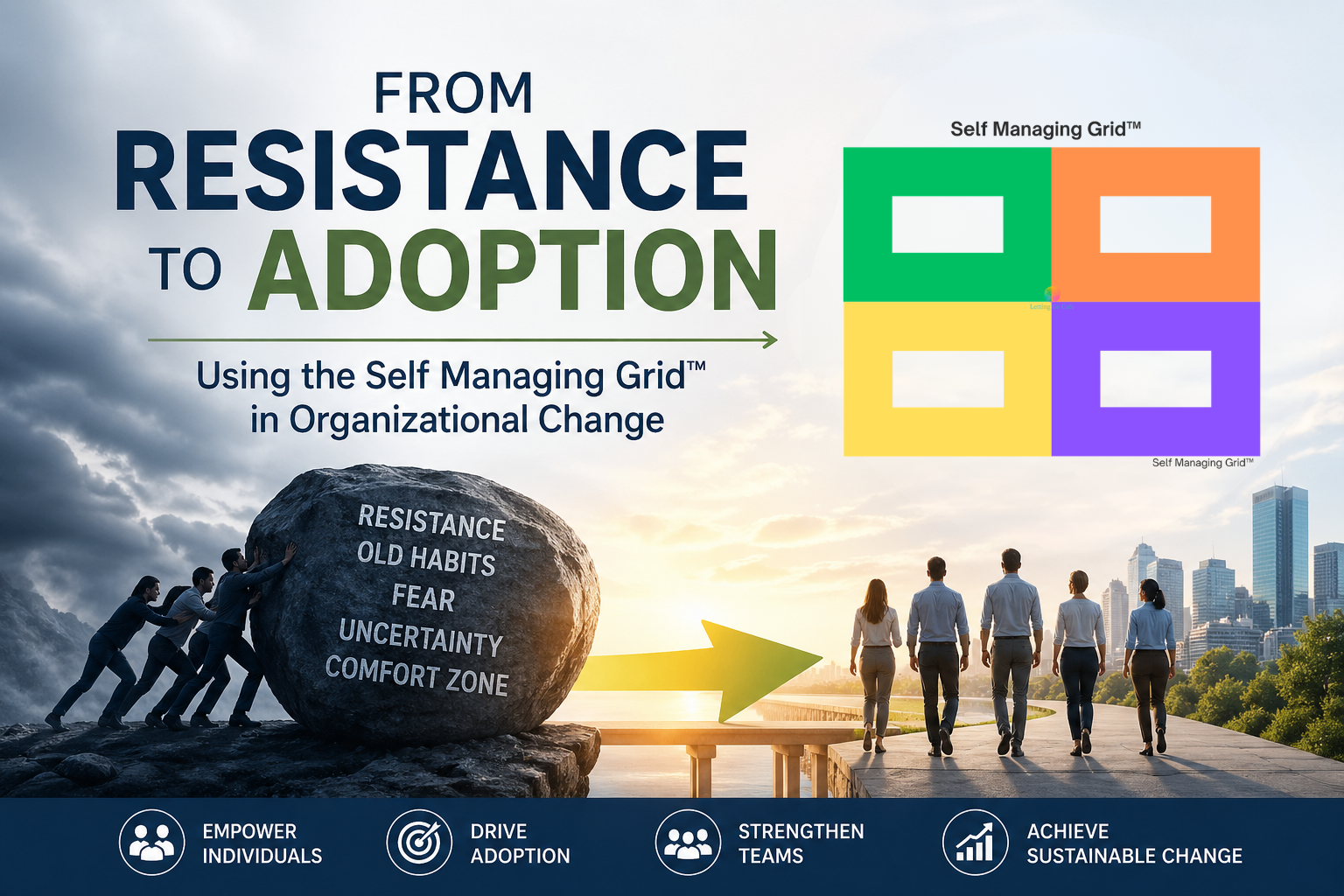
Have you ever noticed how even well-funded change initiatives often fall short of expectations. It rarely comes down to strategy or resources. It comes down to adoption.
In most organizations, resistance shows up quietly, yet with a bang:
- Compliance without commitment
- Delayed decisions
- Partial adoption
- Reversion to old habits
Over the years, working across large-scale transformation efforts, I’ve seen organizations invest heavily in systems, processes, and training. Yet within months, old behaviors return. Workarounds emerge. Momentum fades. The issue is not resistance to change. It is unmanaged human response to change.
That is exactly why I developed the Self Managing Grid®. A framework designed to help individuals and teams recognize, manage, and release the internal patterns that block adoption.
Why Individual Adoption Drives Organizational Success
The data is clear.
- Research from Prosci shows that initiatives with strong individual adoption are 7 times more likely to meet or exceed objectives
- Association of Change Management Professionals (ACMP) emphasizes that sustainable change depends on individuals actively engaging, not passively complying
- A study published in the Journal of Organizational Change Management found that emotional readiness and resilience are among the strongest predictors of successful transformation
Yet most organizations still focus heavily on process and communication, while underinvesting in how people internally process change. This is the gap.
Where Most Change Efforts Break Down
Leaders often assume that clarity drives adoption. In reality, behavior is driven by habit, emotion, and perceived risk.
Research by Wendy Wood shows that a large portion of daily workplace behavior is automatic. This means employees often revert to familiar patterns under pressure, even when they understand the new way forward. Without a structured way to surface and shift these patterns, adoption stalls.
How the Self Managing Grid® Improves Adoption and Usage
The Self Managing Grid® bridges the gap between strategy and behavior. It translates change from something external into something personally manageable.
- Reveals hidden resistance
The Grid helps individuals identify where they are stuck, whether in overcontrol, undercontrol, or avoidance patterns. This makes resistance visible and actionable. - Builds self-awareness at scale
Structured reflection increases cognitive awareness. Studies show that self-awareness improves decision-making and reduces reactive behavior in high-change environments. - Strengthens emotional resilience
Employees equipped with tools to manage stress and uncertainty show higher engagement and lower burnout during transformation. - Enables managers to lead behavior, not just tasks
Managers gain a shared language to coach employees through change, track progress, and reinforce new behaviors. - Sustains behavior change over time
Small, repeated behavioral shifts lead to long-term habit change. This is where adoption becomes embedded, not enforced.
What This Looks Like in Practice
In organizational settings, the Self Managing Grid® is integrated into:
- Leadership coaching sessions
- Team development workshops
- Change readiness and adoption strategies
- Ongoing reinforcement through journaling and reflection tools
The result is measurable.
- Faster adoption cycles
- Reduced resistance
- Increased engagement
- More consistent execution of new processes
It has been my experience that when individuals manage themselves through change, organizations move faster and with greater stability.
3 Immediate Actions Leaders Can Take
- Ask one better question
- Instead of “Do you understand the change?”
- Ask “What feels hardest about this change right now?”
- Normalize the human side of change
- Acknowledge uncertainty and stress openly in team conversations
- This increases psychological safety and engagement
- Introduce structured reflection
- Even 5 minutes per week improves awareness and reduces reactive behavior
- Track behavior, not just milestones
- Monitor adoption patterns, not just project timelines
The Bottom Line
Change does not fail because of poor strategy. Change fails when people are left to manage internal resistance on their own. The Self Managing Grid® provides a practical, research-informed way to close that gap.
Ready to Bring This Into Your Organization
If your organization is navigating a transformation, or if past efforts have struggled to stick, explore the next step:
Leave a Reply